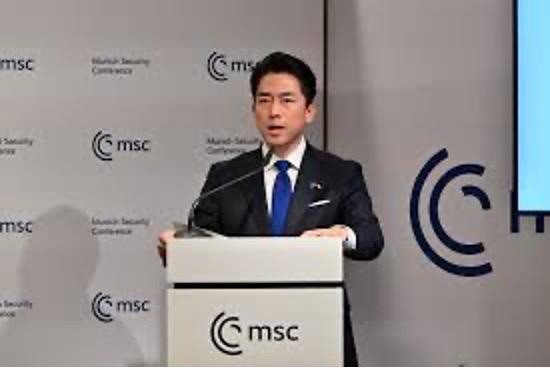
erybody, distinguished guests, ladies and gentlemen, my name is Shinj Koisumi, Minister of Defense of Japan. First of all, I would like to express my sincere gratitude for the invitation to the Munich Security Conference, which is one of the most prestigious and influential platforms for international security in Japan. As he said, election was held on Sunday which turned out to be a historic victory for a ruling party. Even during the two week election campaign period, Japan UK summit meeting was held in Japan where both leaders concurred that the security of the Indo-Pacific and the Euroatlantic is inseparable. On a personal note, this is my first time participating in Munich Security Conference. I was born and raised in Yokoska, a town that embodies the im indis indivisible nature of the Indo-Pacific and Euroatlantic security. Indeed, it was in Yokoska last year where President Trump and Prime Minister Takahichi stood together aboard that US aircraft carrier to address the world. In addition, ships of like-minded countries in Europe have frequently visited Yokoska, including Germany, France, Netherlands, Spain, and Norway. Recently, from August to September last year, the UK carrier strike group led by HMS Prince of Wales also made a port call. As a native of Yokoska, my presence here at the Munich Security Council conference to deliver a speech as minister of defense is a testament to the fact that the security of both region is inseparable. I would like to once again express my gratitude to everyone involved in the MSC for the precious opportunity. Today I would like to focus on three points. First, Japan's initiatives in security policy. Second, our security concerns and Japan's fundamental stance. And third, further strengthening of cooperation with ally and like-minded countries. First, Japan's efforts in security policy, the rule of law, freedom of navigation, respect for sovereignty. Over the 80 years since the Second World word world war, the very foundations that have underpinned the international order are being tested by real world actions. This is the situation we are now facing. Russia's aggression against Ukraine in 2022 demonstrated that the crisis in one region is directly linked to global security. In other words, as I mentioned earlier, the crucial point here is that the security of the Indo-Pacific and Euroatlantic is indivisible. Attempts to unilaterally change the status quo by force must never be tolerated. That is why Japan does not view Ukraine as a distant European problem. Countries surround sounding Japan continue opaque military buildup and the regional military balance has been greatly and rapidly evolving. In the East and the South China Seas, attempts to change the status quo by force persist. In the Western and the Southern Pacific, provocative military activities are intensifying. Based on this recognition, the Takahicha administration is squarely addressing measures to ensure the security of our country. First and foremost, Japan itself will become stronger. We are committed to sustaining our efforts to fundamentally reinforce our defense capabilities and increase our defense spending. With last year's supplementary budget, we achieved a level of defense spending at 2% of GDP ahead of the schedule, original schedule. Immediately after taking office last October, Prime Minister Takahichi directed an accelerated revision of Japan's national security strategy. Under her leadership, we will revise it within this year. We will also continue to respond to any crisis in a resolute and composed manner. In doing so, strengthening the defense production and technological base which we deem as defense capability itself is also indispensable. We need to work closely with industry and across the government to establish resilient supply chains, flexible production systems and incorporate advanced civilian technologies. The use of outer space is a very foundation of our modern lives. The MOD is rapidly strengthening our defense capabilities in the space domain. In fiscal year 2026, Japan will rename our air self-defense force to Japan air aerospace self-defense force. Second, our security concerns and Japan's fundamental stance. Today, the Indo-Pacific region faces a crisis. One of them is the weaponization of everything. the weaponization of economy, technology, resources, information and cyerspace. The boundary between peace time and contingency, between military and non-military, between truth and fake news. These are no longer clearly visible. We are living in an era of uncertainty where anything can happen. The intentions of aggressors can hardly be predicted by those of us living living in democracy. Aggressors may also misjudge the strengthen of our resolve. Anything could happen tomorrow. I believe you share this sense of crisis. We must confront this reality head on and ensure peace and stability in the region. Let me be clear. Japan keeps the door to dialogue open at all times even when fundamental differences in stance exist. Indeed, precisely because of these differences, we maintain close communication and mutual exchanges. Together with like-minded partners, Japan will fulfill its responsibilities to maintain an international order free from aggression. Japan seeks to be a partner that contributes to the peace and stability of the international community through security cooperation. One that spans the entire globe. Third, further strengthening of cooperation with our ally and like-minded countries. First, we will further strengthen the Japan US alliance. Last month I visited Washington DC to hold a Japan US defense ministerial meeting. The fourth meeting with Secretary Hexes in the short period of time since my appointment. We confirmed that the Japan US alliance remains unwavering and that both countries are working in lock step. The Japan US alliance has evolved to contribute to stabilizing the global security environment. For example, even at US Africelnel
is dispatched to facilitate coordination between the US forces and the Japan self-defense forces. Next, we will spread a multi-layered network of interconnectivity across the entire world. Starting from the Indo-Pacific with the partners of the Indo-Pacific and all the like-minded nations, including our partners here in Europe as well. We will enhance connectivity and generate synergies not only in training and operations, but also across equipment and industrial bases. Just last month, the annual Japanese paratroopers exercise New Year's jump hosted by Grand Self-Defense Force had included 14 nations of ally and like-minded countries. In addition to strengthening relations with ally and like-minded countries, Japan NATO relationship is making steady progress as demonstrated by the deepening engagement of the IP4. Japan, ROK, Australia and New Zealand through invitations to NATO defense ministerial meeting. My personal relationship with Secretary General Rut with whom I met today is also unprecedented having met for three months in a row since December of last year. We will continue to closely cooperate with each other as the security of the Euroatlantic and Indo-Pacific is inseparable. Our cooperation is also moving beyond into the realm of actual operations. I'd like to highlight an example of a joint response to global challenges. Last November, when pirates boarded a private tanker off the coast of Somalia, Japanese self-defense forces force P3C rushed to the scene. Based on from the intelligence provided by the SDF, the maritime forces of the EU and others safely rescued the crew and the hijacking attempt was thwarted. In terms of defense equipment cooperation, the next generation fighter is being developed through a partnership between Japan, UK and Italy. This global combat air program is designed by its very nature with our ally and like-minded countries in mind. As the name global suggests, it reflects our commitment to future interoperability with partners across the globe, including here in Europe. Against this backdrop, the Japanese government is currently working on the review of so-called five categories rule in the transfer of defense equipment with a view to expanding its scope. In 2007, Japan's then Prime Minister Abbe delivered a speech titled Confluence of the Two Seats in the Indian Parliament. In the speech, he declared that the Pacific and the Indian Ocean are now bringing about a dynamic coupling as seas of freedom and prosperity. Today, these two seas have expanded to three, the Pacific, the Indian and the Atlantic oceans. Dear friends, as the Munich rule aligns, let us strive to engage and interact between Japan and Europe. Thank you very much for your kind attention.
Thank you so much, Minister Quisumi. Uh we don't have very much time, so let's jump uh straight into it. Uh I don't believe I heard you mention China directly. Uh yet China is central to the strategic landscape. Uh tensions between Japan and China have been fraught uh to say the least in recent um in recent times. How might Japan uh seek to manage this relationship moving forward? Thank you very much. uh as far as uh I feel from the audiences uh you your question is uh very welcomed by the audiences. Uh actually last year I met my Chinese counterpart uh Minister Don Jun in Malaysia uh when we had a meeting with Asan countries it's called ADMM plus uh even though we have differences and we have disagreements Japan's stance is very clear we are always open to the dialogue uh So we are not going to shut down any channels uh regardless of differences. So I would like to send this message to Chinese side that we are always welcome to the dialogue. Fantastic. That's reassuring. Uh, of course, apart from dialogue, um, central to ensuring peace and stability in the region, um, and Japan understands this more than anyone else is, uh, deterrence and working together with allies and partners. Let's turn now very quickly to the US Japan alliance. Uh, here in Europe, um, I think it's fair to say that there is some concern over US security commitment. Um the United States has questioned its commitment to Europe, not least in the last Munich Security Conference. Uh it's also in the interim threatened to uh take Greenland. Uh is Japan worried about the credibility of the US Japan alliance? I know you talked about meeting um your counterpart in the United States, but there is a lot of at stake for uh Japan. And is it in its upcoming national defense uh security review? Is it reviewing its position um uh to factor in um allies and also in particular is it reviewing its position on uh nuclear nuclear policy? Thank you very much. Uh going back to your first point on the relationship between US and these allies uh including Japan and also European countries. Uh I just had a meeting with uh Secretary General Rut uh today and I know yesterday there was very important meeting with uh between NATO defense ministers uh including US uh participant. Uh I was very happy to hear that uh the atmosphere and the discussion was very positive uh between the American side and European side. uh because from Japanese point of view uh if uh there is a tension um between the US and Europe Europe and NATO who is happy with this we should think about this so as I keep saying that Japan US ally alliance is unwavering it's very strong um our prime minister Takichi going to visit at Washington DC in next month. Uh so yeah, I think it's always important to keep closely uh communicate with not just between Japan and the US but also with NATO. That's why uh we attended uh NATO ministerial meeting under the IP4 and also this is my presence here at Munich Security Conference is also a message to the European friends that Indo-Pacific and Euroatlantic is inseparable. For example, can I add add one thing? uh for example uh North Korean soldiers have been sent more than 10,000 soldiers have been sent to Russia and Russia have sent you know North Korean soldier to Ukraine then they are learning uh new way of fighting with drones AI and cyerspace and with all domains with conventional weapons then getting back to uh North Korea Then we need to think about what they are using for and who they are using against. So uh that's why I said Ukraine is not a distant problem. So you've been exceedingly clear um crystal clear about um how important uh both regions are to each other. And yet in the recent US national defense security uh national defense strategy, the United States says that it would be clear with its European allies that their efforts and resources are best focused on Europe. That's so that's the US view. What does Japan think of the division of labor between theaters and does Europe play an important role in Asia? Yes. uh it's always important to strength uh by ourel uh that's why I send a message that Japan is going to strengthen our defense policy itself so it's very natural for everybody uh based on the new security environment around the world uh which is very severe and serious uh yeah we need more spending uh we need more investment including defense industries And so you know co- production issue is one of the issues between Japan and the US and we could do something with Europe too. Uh that's why I mentioned our project for the new fighter jet uh GCAP with Japan, Italy and the UK. Yeah. So yeah this is uh what we are now uh thinking about. And going back to your second point on the last questions on our new strategy, uh we need to find out a new Japanese way of uh confronting a new type of warfare with drones and cyerspace and also AI. uh it's not just a copy of what we are seeing from the Ukraine and Russian battlefield because we are a mamm country. So we need to find uh by ourselves what's the best way for Japan to do. Yeah. Thank you. So um just on the final question and I believe this this is very close to your heart um the landslide victory um in Japan, how was security policy communicated and presented to the Japanese public and can one take away from this election um a strong mandate uh for uh some of the defense uh changes that are uh ahead of uh Japan or should we read it more as perhaps a mandate for your prime minister's economic policies because I understand that voters had at the top of their concern um cost of living issues as well as you know other breadandbut economic issues. Yeah, of course for the election uh economic policies and social security policies uh the top high priorities for the general public. But in this election in Japan, uh I kept talking about security policies uh you know we need to strengthen uh you know investment uh to the defense industry. We need to revise the security documents. Uh we need to improve uh the treatments to the self-defense force personnel including their families. um people welcomed uh that's why this result of the election was very powerful and it gave me a courage to push our security policy but of course uh we are living in a democrac democracy so with a powerful uh message from the public but also we need to be very very uh you know um careful to explain why we need to ex uh strengthen our security policy by explaining what we are seeing around us. Yeah. Thank you so much minister for sharing your insights. Uh please join me in thanking the minister. I feel it was far too short. Um but thank you. Thank you very much.